 Devices and comparisons
EF-i limescale unit: the 12 questions installers actually ask
We collect the questions that come up on every site visit and answer them straight: what happens to the limescale, what maintenance to promise the customer, how it is fitted, which sizes cover each installation and what equipment it lives alongside. With the full FAQ video.
One question comes up on every site visit, almost always in the same words: "so where does the limescale actually go?". Behind it sit eleven more that recur just as insistently, and all of them have a concrete answer. This article collects them in the order they tend to arise, so an installer can settle them in front of the customer without digging out a datasheet.
What the unit does, in one sentence
The EF-i is a physical water treatment unit for open circuits, meaning the whole plumbing installation of a home, a building, a residential block or an industrial site. It does three things at once, automatically and with no intervention:
It increases the water's dissolving power
The internal geometry creates a vortex that multiplies the water's kinetic energy. Instead of letting limescale settle, the water carries it away.
It transforms scaling limescale
A Venturi restriction accelerates the flow and sets the internal stainless steel cylinders vibrating. The resulting low-frequency sonicophysical waves turn calcite into microcrystals with no ability to adhere.
It removes limescale that was already there
Those same waves propagate along the pipework and break up existing layers. That is the curative effect: the unit does not just prevent, it also cleans up what came before.
No electricity. No salt. No chemicals. No maintenance. And with a 10-year warranty.
1. Where does the limescale go? And what good does that do me?
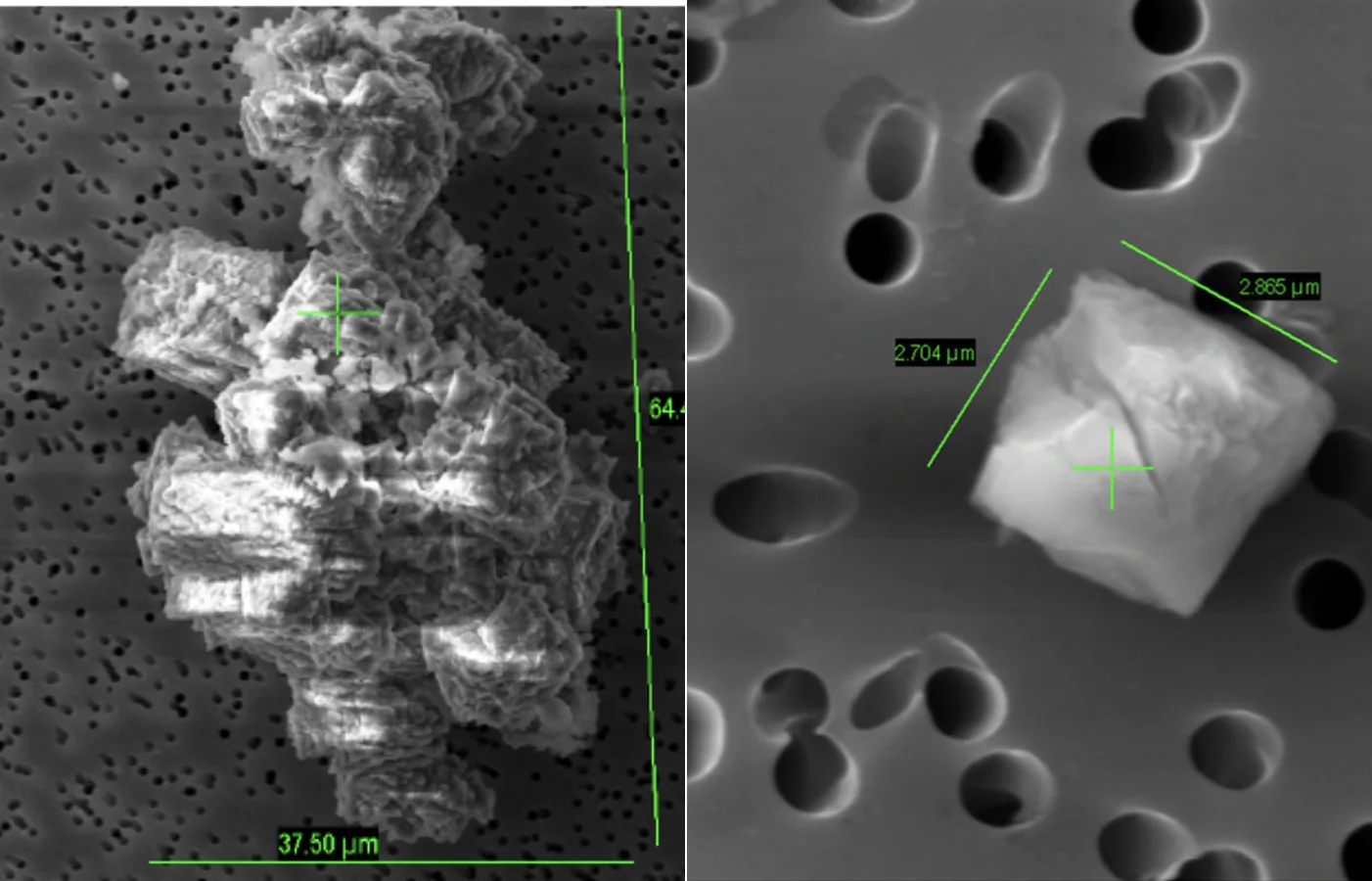
The limescale does not disappear from the water, and it is worth saying so plainly, because any other answer breeds distrust the moment the customer looks at a water analysis. What the unit does is change its form. Scaling limescale, calcite, is transformed into microcrystals with no ability to adhere to pipe walls or to any component. They pass through the installation without sticking and leave through the drains with the normal flow of water.
What good it does: pipes do not block, boilers, cylinders, heat exchangers and appliances do not build up crust, flow is maintained and so is thermal efficiency. And on top of that, the curative effect removes what was already there. It is not that nothing is done about the limescale: it is that it is managed in the most efficient way available, without chemicals and without maintenance.
2. What maintenance does it need? 3. What does it add to running costs?
None, and that is the honest answer. No filters to change, no salt to top up, no mandatory periodic service visits and no inspections. The unit is completely autonomous. It is made from INOX 316L stainless steel, the same grade used in the food and medical industries, and it has no moving parts to wear in the conventional sense.
On running costs, the same: no electricity, no salt, no chemicals and no filters. Additional consumption after installation is zero.
For an installer this is a first-rate commercial argument. When you sell a customer something and never have to go back for breakdowns or consumables, that builds trust and keeps the relationship. When what you sell requires an annual return, the relationship is different.
4. How long does the unit last?
The official warranty is 10 years. There is something important to add: with no moving parts and no consumables, real service life goes well beyond that warranty. DRAG'EAU has been fitting units since 2011 and the first ones installed are still working. The durability of 316L stainless steel in a water environment is effectively indefinite under normal conditions.
5. Is it easy to fit? Where exactly does it go?
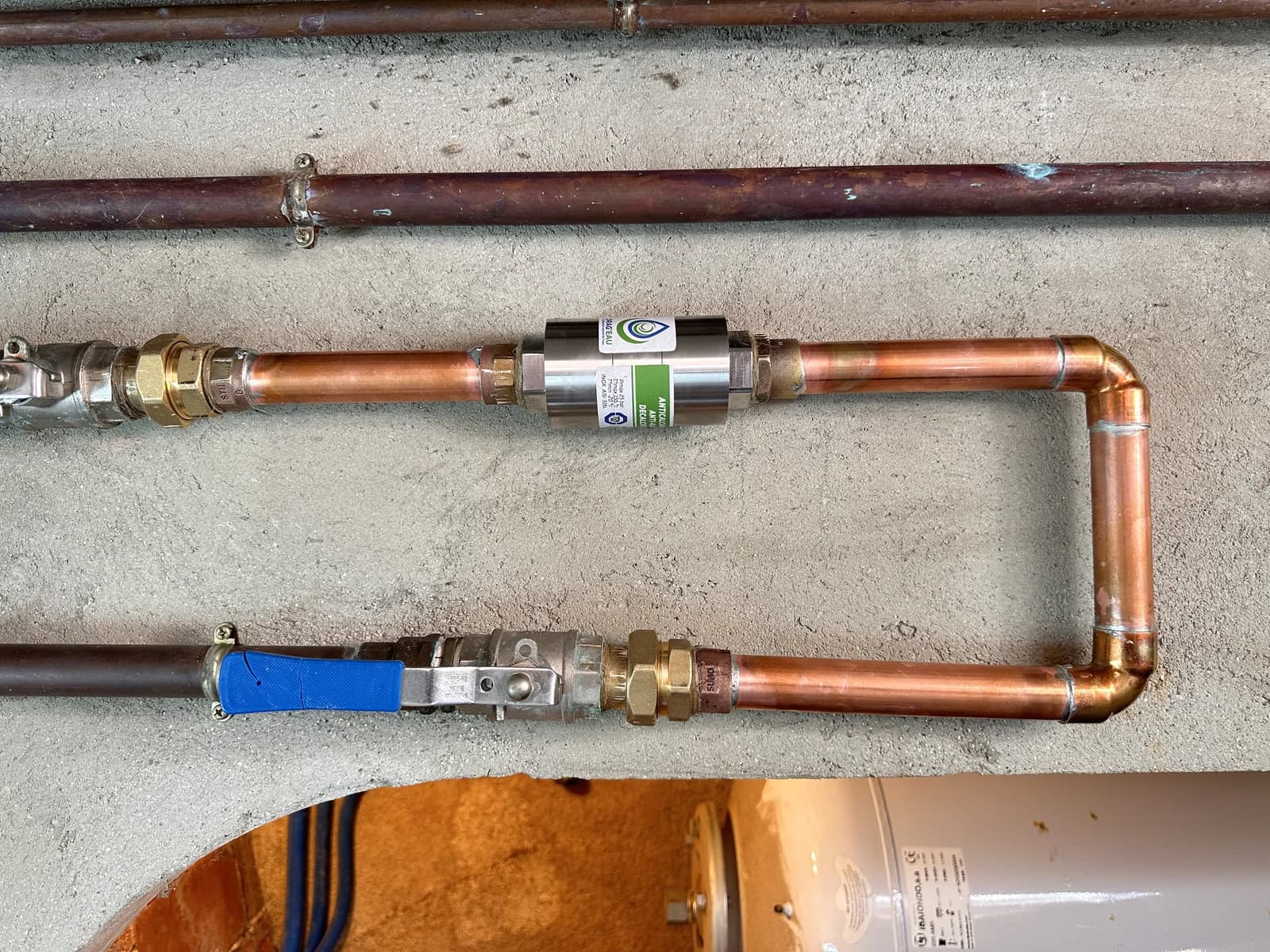
It goes on the main cold water supply, downstream of the meter or of the sediment filter if there is one. The connection is standard threaded, like any other plumbing fitting. Any installer can fit it in under an hour.
There are only two conditions to observe, and both matter:
- At least 20 cm of straight pipe before and after the unit, with no elbows, valves or tees in between. That is what lets the vortex effect form properly. Without it, the unit will not perform as it should.
- Do not weld directly onto the unit. Weld the pipework first, let it cool, then screw the unit in. Welding on the body compromises the seals.
6. Does the pipe material matter?
No. The unit is compatible with any material: copper, steel, PVC, PE, multilayer, polypropylene. The effect is generated inside the unit and the waves propagate through the water, not through the pipe wall, so the material does not affect the result. That is a considerable advantage in older installations, where you find everything and not always documented.
7. What sizes are available?
The range covers everything from a single-family house to an industrial installation. Smaller sizes are threaded; from DN65 upward, mounting moves to PN16 flanges.
| Reference | Connection | Nominal diameter | Maximum flow | Mounting |
|---|---|---|---|---|
| EF-i15 | ½″ | DN15 | 0.9 m³/h | Female thread |
| EF-i20 | ¾″ | DN20 | 2.7 m³/h | Female thread |
| EF-i25 | 1″ | DN25 | 4.2 m³/h | Female thread |
| EF-i32 | 1″¼ | DN32 | 5.9 m³/h | Female thread |
| EF-i40 | 1″½ | DN40 | 11.2 m³/h | Female thread |
| EF-i50 | 2″ | DN50 | 17.8 m³/h | Female thread |
| EF-i65 | 2″½ | DN65 | 27 m³/h | PN16 flange |
| EF-i80 | 3″ | DN80 | 41 m³/h | PN16 flange |
| EF-i100 | 4″ | DN100 | 87 m³/h | PN16 flange |
| EF-i150 | 6″ | DN150 | 285 m³/h | PN16 flange |
Data from the official datasheets. The three most common sizes are EF-i15 and EF-i20 in homes, EF-i25 in apartment blocks and commercial buildings, and EF-i50 on high-flow installations.
Pipe diameter alone is not enough for sizing: you have to look at the installation's real peak flow. The configurator does that cross-check, and the datasheets by size are in technical documentation.
8. Is there a pressure drop? And internal friction wear?
Two questions that go together because their answers are related. Pressure drop exists, as it does with any fitting inserted into a pipe, but it is small and comparable to a standard sediment filter. On normal installations it is not a problem.
As for wear: the unit generates the vortex effect and the waves through internal geometry and stainless steel cylinders, but that vibration is low intensity. There is no significant erosion, and that is precisely what makes it possible to guarantee ten years of service life with no maintenance.
9. What are the pressure and temperature limits?
25 barWorking pressure
-20 to 155 °CTemperature range
70 °fMaximum hardness accepted
The range comfortably covers the usual mains pressures in Spain, which normally sit between 2 and 6 bar. On temperature, the margin allows the unit to be fitted on domestic hot water lines and even on high-temperature industrial applications.
10. Is it compatible with a softener or reverse osmosis?
Completely. If a softener is already fitted, the EF-i goes upstream, before the softener, and enhances its effect: as the water no longer scales, the softener can be set to a higher residual hardness and its salt consumption falls. With reverse osmosis there is no possible interference, since it works at the point of use.
What tends to happen afterwards is that the customer finds their softener no longer feels essential, and some end up removing it. That is their call: compatibility is guaranteed either way. The full comparison between the two technologies is in this article.
11. Does it affect water quality? Can you still drink it?
Yes, the water is drunk exactly as before, and the question is entirely legitimate. The EF-i does not alter the chemical composition of the water: it removes no minerals, adds no substance and does not change the pH. The only thing that changes is the physical structure of the limescale, from scaling calcite to non-scaling microcrystals. The water is the same water, with the same minerals. What can be noticed is the sensation in the mouth: fragmented limescale takes the edge off some of the harshness typical of hard water.
The unit holds the Attestation de Conformité Sanitaire (ACS), the French certification authorising its use in drinking water installations, including premises open to the public. Alongside it sit German TÜV SÜD certification and DVGW. All of them are detailed on the certifications page.
12. Does it work with well water?
It may, but it has to be assessed case by case. The EF-i is designed and optimised for public mains water. Well water can have a highly variable composition, with uneven hardness and the presence of iron or manganese, and that affects performance. If the customer has a well, the correct approach is a specific assessment before fitting, not a promise.
Other questions that come up on site
Can it be fitted horizontally and vertically?
The unit accepts both positions as long as the 20 cm of straight pipe before and after is respected. What must not be done is fitting it immediately after an elbow, a valve or a tee, whatever the orientation.
Is a bypass needed?
Not mandatory, since the unit needs neither maintenance nor taking out of service. In communal installations one is fitted anyway as an operational choice, so the section can be isolated without cutting the main supply.
How long until the effect shows?
The preventive action is immediate: from the first moment, the limescale passing through stops being scale-forming. The curative effect on existing deposit is progressive and depends on the starting condition. On heavily scaled installations it is measured in weeks or months.
Can it be fitted on the hot water line only?
It is better fitted on the main cold water supply, before the split, because one unit then protects the whole installation. Fitting it on the hot line alone leaves the cold water network, the taps and the appliances untreated.
What should I tell the customer they will notice?
That new deposits stop appearing on taps and shower screens, that hot water flow stabilises and that existing crust gives way progressively. What they will not notice is a change of taste or a change in the hardness analysis, and it is worth saying so in advance so they do not read it as a failure.
How do I become an official installer or distributor?
Through DRAG'EAU Ibérica's distribution network, which covers Spain, Portugal and Andorra. The distributors page has the locator and the route to registering new points.
How to present it to a customer
Answering the technical questions well is half the job. The other half is the order in which you tell the story. This video walks through the sales argument for both units.
About this article
Written by the DRAG'EAU Ibérica technical team, drawing on the product range's technical data sheets, product certificates and hands-on installation experience across Spain, Portugal and Andorra. Ranges and estimates are identified as such in the text.
More from the blog
Keep reading
Devices and comparisons Limescale and hardness
What limescale really is and why it sticks to your pipes
Everyone sees it on the shower screen and on the immersion heater, yet few know what it actually is or why it bonds. This guide walks through the whole mechanism: where limescale comes from, the reaction that makes it precipitate, what it costs an installation and which families of treatment exist today.11 min read Sludge and heating
Sludge in closed circuits: why it appears and how to get rid of it
The water in a closed circuit is never renewed, so it does not have a limescale problem: it has a corrosion problem. We explain where magnetite comes from, why underfloor heating is the most delicate case, how much energy is lost and what the four available solutions really do.12 min readNewsletter
We'll tell you about every new article
We publish technical guides on water treatment, with no fixed schedule and no filler. Leave your email and we'll let you know when the next one is out.