
 Sludge and heating
Sludge in closed circuits: why it appears and how to get rid of it
The water in a closed circuit is never renewed, so it does not have a limescale problem: it has a corrosion problem. We explain where magnetite comes from, why underfloor heating is the most delicate case, how much energy is lost and what the four available solutions really do.
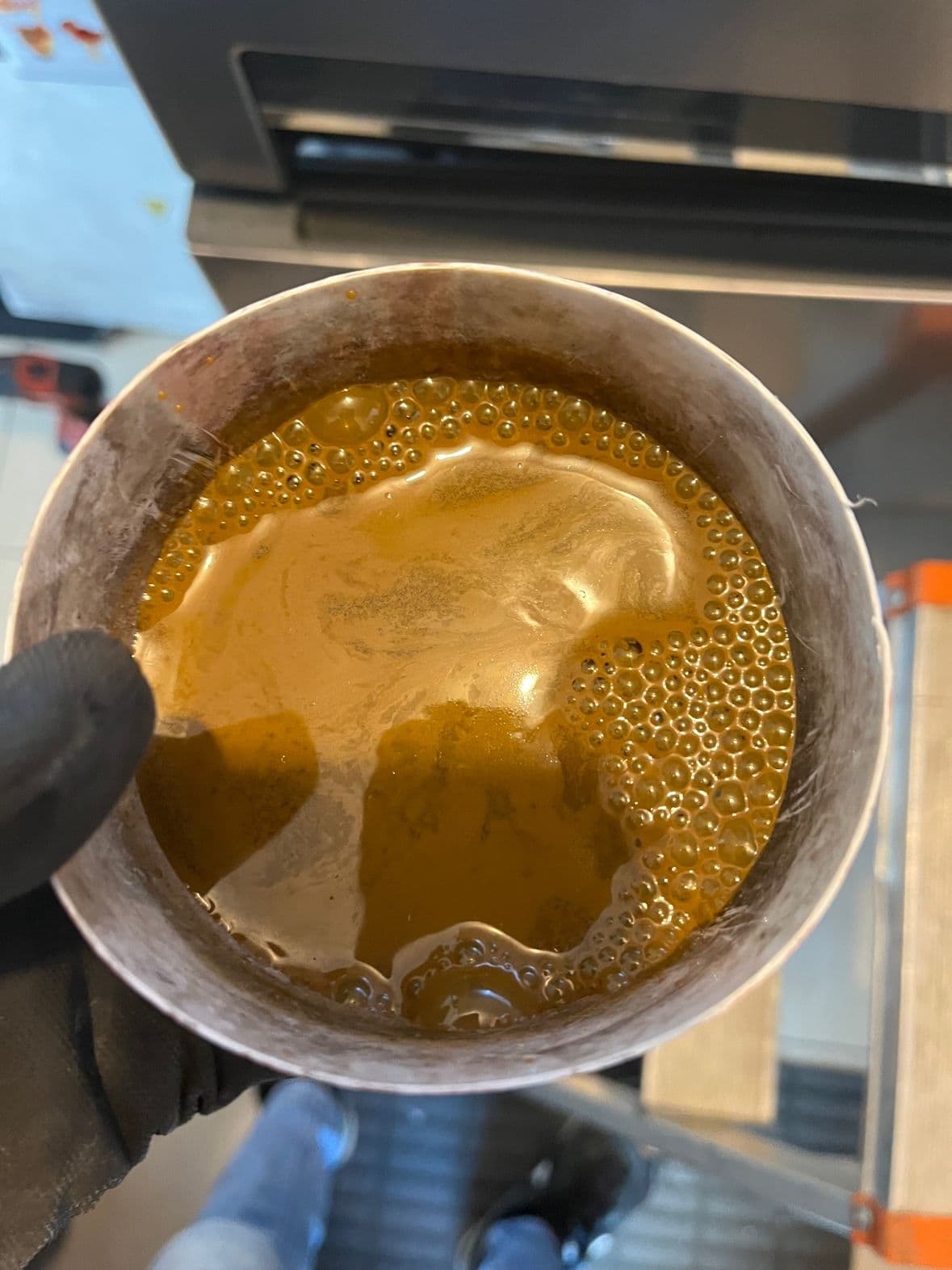
In a closed heating or cooling circuit the water is never renewed. That means the calcium it contained precipitated once, at the beginning, and the limescale story ended there. A closed circuit's problem is a different one, and it builds over time: internal corrosion generates sludge, a mixture of iron oxide, metal particles and biofilm that settles in low points, coats heat exchangers and ends up behaving like thermal insulation.
It is a silent problem. No breakdown announces it: there is a radiator that heats less well than last year, a boiler that fires more often and a bill that creeps up without anyone quite knowing why.
Fe₃O₄magnetite, the dominant component of black sludge
Insulatorsludge conducts heat far worse than steel does
Weekshow long a badly fouled circuit takes to show improvement
What circuit sludge actually is
The black sludge that comes out of a radiator bleed valve is mostly magnetite, the iron oxide that forms when the steel in the circuit corrodes in the presence of water and oxygen. Other components sit on top of that base and explain why the deposit is so heterogeneous:
- Iron oxides, from steel radiators, black steel pipework and pump bodies.
- Copper and aluminium particles, stripped by galvanic corrosion wherever different metals share a circuit.
- Bacterial biofilm, which thrives particularly in circuits running at low temperature.
- Installation debris: swarf, flux residue, hemp fibres and dirt left inside on fitting day.
- Residual carbonate, the small amount that precipitated from the initial fill water.
Where the oxygen comes from, if the circuit is closed
That is the right question, because a genuinely sealed circuit corrodes once and then stabilises. If sludge keeps forming year after year, oxygen is getting in, and there are only so many possible routes:
- Frequent top-ups. Every refill brings in fresh water loaded with dissolved oxygen. A circuit that needs topping up often has a leak, and that leak is what feeds the corrosion.
- Pipework without an oxygen barrier. Some plastics are permeable to atmospheric oxygen. In underfloor heating this is a classic of older installations.
- Expansion vessels that are undersized or have lost their charge, letting air in during pressure dips.
- Faulty automatic air vents, which let air in rather than out.
- Galvanic corrosion, which needs no external oxygen at all: steel, copper and aluminium sharing a circuit is enough.
The symptoms that give a sludged circuit away
- Radiators cold at the bottom and hot at the top. Sludge settles by gravity and fills the base of the element.
- Radiators that never heat at the end of the run, while the first ones work fine.
- Black or dark brown water when bleeding, with particles in suspension.
- Circulation noise, gurgling or banging in pipework and boiler body.
- The boiler cycles on and off constantly, in short bursts, because it cannot shed the heat it produces.
- Consumption rising with the same usage and the same setpoint as the previous year.
- A circulating pump that seizes or fails more than once.
- Underfloor heating with lukewarm zones and uneven distribution between loops.
When three or four of these appear together, the diagnosis is rarely wrong. The simplest test is to drain at the lowest point of the installation and look at the water that comes out.
What a fouled circuit costs the installation
Sludge conducts heat far worse than the metal it settles on. A thin layer on the inner surface of a radiator or a heat exchanger is enough to degrade heat transfer, and the consequence is always the same: the boiler has to work harder to deliver the same room temperature.
| Component | What happens to it | Consequence |
|---|---|---|
| Radiators | Sludge coats the inside and fills the base | Reduced useful surface and uneven output |
| Boiler heat exchanger | The flow path fouls up | Short cycling, falling efficiency, overheating |
| Circulating pump | Works against more resistance and with abrasive | Higher draw, wear and seizures |
| Thermostatic valves | Seize up with sediment | Control becomes impossible, radiators run free |
| Underfloor heating | Deposit in small-bore tubing | Reduced flow and uneven heat |
| The circuit as a whole | Less flow, more pressure drop | More energy for the same comfort |
On top of that sits the cost of failures. A pump replaced, a heat exchanger stripped and acid-cleaned, a set of thermostatic valves changed: all of them get written off as wear and tear when in fact they share one cause upstream.
In industrial installations the arithmetic is on another scale. Circuits are larger, chemical maintenance is expensive, and a production stoppage caused by a circuit failure runs to figures that bear no comparison with the cost of the unit that would have prevented it.
Why underfloor heating is the most delicate case
Underfloor heating combines two conditions that make it especially vulnerable to sludge. The first is geometric: the pipes are small-bore and very long, so any deposit noticeably reduces flow, makes heat distribution uneven and, in severe cases, can block a whole loop.
The second is thermal: underfloor heating runs at low temperature, typically between 30 and 45 °C, which is exactly the range that favours bacterial biofilm growth. That biofilm adds to the oxide and accelerates fouling.
And there is a third, practical reason: underfloor heating cannot be taken apart. A radiator can be lifted off and flushed; a circuit buried in the screed cannot. Anything that keeps it clean from the inside is worth twice as much.
The four available solutions and what each one does
Chemical flush
Drain down, circulate a descaling and dispersing product, then rinse. It is a curative, one-off operation: it leaves the circuit clean that day. It does nothing to stop sludge forming again, so it has to be repeated.
Corrosion inhibitor
A chemical dosed into the circuit water to slow corrosion. It works as long as the concentration holds, which means checking it and redosing after every drain-down or significant top-up.
Magnetic filter
A canister fitted on the return that captures ferrous particles already in circulation. It retains, but it does not stop them forming and does not act on what is stuck to the walls. It has to be emptied regularly.
Permanent physical treatment
A unit fitted into the circuit that continuously keeps particles in a non-adherent state, with a curative effect on the deposit already there. No product, no consumables and no dosing to monitor.
The first three complement each other and all share the same limitation: they depend on a recurring action. The detailed comparison between the magnetic filter and permanent treatment is in this article.
The DS-i sludge unit: what it does and where it goes
The DS-i is DRAG'EAU's closed-circuit unit, and it works on the same physics as the limescale unit: the internal geometry spins the fluid into a vortex, a Venturi restriction accelerates it and that acceleration generates low-frequency sonicophysical waves. On suspended particles (oxide, sludge, biofilm) the effect is to keep them in a non-adherent state: they stop sticking to pipe walls and components, remain suspended in the fluid and are flushed out naturally through the air vent or the drain point at each purge.
The curative effect works as it does on the limescale side: if sludge is already stuck fast, the unit breaks that deposit up until the circuit is clean. Not all at once, and that is deliberate: deposits come away gradually, as fine particles, which avoids fragments large enough to block a component downstream.
- It is fitted on the circuit flow, after the pump.
- Standard threaded connection, like any circuit fitting.
- Straight pipe before and after, with no elbows or valves immediately alongside.
- No welding on the unit: pipe first, let it cool, then screw the unit in.
- No external consumption: no electricity, no water, no consumables. The circuit's own hydraulic energy drives the mechanism.
- Compatible with any material: black steel, copper, multilayer, polypropylene.
An installer used to heating circuits fits it in under an hour. The range covers everything from half an inch, for domestic installations, up to flanged models for large industrial circuits and district heating.
How long does a circuit take to clean up?
It pays to be honest about timescales, because that is where customers are most easily disappointed by an overpromise. On a circuit in reasonable condition, the effect shows within a few weeks. On a badly degraded circuit, with years of accumulated sludge and corrosion, the process can take several months.
What should be planned for is an initial purge after fitting, to remove the first sludge the unit dislodges, and the odd purge during the first few months if the circuit had gone a long time without maintenance. That is not extra work: it is what an installer already does at a normal heating service.
Frequently asked questions about sludge and closed circuits
Where does the sludge go if the unit does not filter it?
It stays suspended in the fluid without adhering to the walls, and it is flushed out through the air vent or the circuit drain point during a purge. It does not vanish on its own: it is prevented from settling and then removed during the purge, which is routine maintenance.
Does it work if my circuit already has chemical treatment or glycol?
Yes, there is no incompatibility or reaction between them. The usual approach is to fit the unit and keep the chemical treatment through a transition period, while the circuit cleans up, then reduce the dose progressively until it is dropped.
Can the unit damage a badly fouled circuit while cleaning it?
No, because the release is gradual and controlled. Deposits come away as fine particles rather than plates, precisely to avoid fragments capable of blocking a valve or a heat exchanger. On very degraded circuits a prior chemical flush is recommended and shortens the process.
What maintenance does the unit need?
None from the unit itself: no moving parts, no electrical consumption, no consumables and no scheduled servicing. What is recommended is the initial purge after fitting and the occasional purge during the first months if the circuit was heavily loaded.
Does it also work for cooling and air conditioning circuits?
Yes. Every closed circuit has the same problem: fan coils, air conditioning systems, process heat circuits, cooling towers and district heating networks. The treatment logic is the same as in heating.
Is treating closed-circuit water a legal requirement?
Spanish building services regulations require water treatment to be provided for closed circuits in order to prevent corrosion and scaling. How to comply is left to the designer, and that is where the choice between chemical and physical treatment is made.
About this article
Written by the DRAG'EAU Ibérica technical team, drawing on the product range's technical data sheets, product certificates and hands-on installation experience across Spain, Portugal and Andorra. Ranges and estimates are identified as such in the text.
More from the blog
Keep reading
Sludge and heating Limescale and hardness
What limescale really is and why it sticks to your pipes
Everyone sees it on the shower screen and on the immersion heater, yet few know what it actually is or why it bonds. This guide walks through the whole mechanism: where limescale comes from, the reaction that makes it precipitate, what it costs an installation and which families of treatment exist today.11 min read Devices and comparisons
EF-i limescale unit: the 12 questions installers actually ask
We collect the questions that come up on every site visit and answer them straight: what happens to the limescale, what maintenance to promise the customer, how it is fitted, which sizes cover each installation and what equipment it lives alongside. With the full FAQ video.13 min readNewsletter
We'll tell you about every new article
We publish technical guides on water treatment, with no fixed schedule and no filler. Leave your email and we'll let you know when the next one is out.