 Limescale and hardness
Water treatment glossary: 60 terms explained
Water treatment vocabulary sits across chemistry, plumbing and regulation, which makes it easy to get lost. This glossary gathers the sixty terms that turn up in any quotation, datasheet or water quality report, explained without jargon and grouped by theme.
Water treatment has a vocabulary that crosses three trades: chemistry, plumbing and regulation. The result is that the same concept appears under two different names depending on who wrote it, and that precise terms sit alongside loosely used ones in the same quotation. This glossary sorts out the sixty you need in order to read a datasheet, a water quality report or a quotation with judgement.
It is grouped into three blocks: water and its hardness, the equipment and its installation, and closed circuits. Alphabetical within each.
Water and its hardness
- Alkalinity
- The water's capacity to neutralise acids, tied mainly to its bicarbonate content. Together with hardness and pH it determines whether water tends to scale or to attack metals.
- Aragonite
- A crystalline form of calcium carbonate with a fine needle structure. Unlike calcite it does not bond to walls: it stays in suspension and the water carries it away. It is the form physical treatment aims for.
- Calcite
- A crystalline form of calcium carbonate with a compact rhombohedral structure. It is the one that bonds to walls and grows in layers into a crust. The cause of scaling.
- Calcium bicarbonate
- The soluble salt water forms as it passes through limestone carrying dissolved carbon dioxide. It is stable while the water stays cold; on heating it releases CO₂ and precipitates as calcium carbonate, which is no longer soluble.
- Calcium carbonate
- CaCO₃. The compound that precipitates when hot water loses carbon dioxide. Insoluble, it is the material scale is made of.
- Conductivity
- A measure of the water's ability to conduct electricity, proportional to the total quantity of dissolved salts. Expressed in microsiemens per centimetre, it serves as a quick indicator of overall mineral content.
- French degreehydrotimetric degree
- A hardness unit equal to 10 mg/L of calcium carbonate. It is the usual reference in Spain and Portugal. Written °f or °fH, always with a lower-case f so it is not confused with degrees Fahrenheit.
- German degree
- A hardness unit equal to 17.85 mg/L of calcium carbonate. One German degree is 1.79 French degrees. Written °d or °dH, it appears often in appliance manuals.
- Hard waterlimey water
- Water with a high content of calcium and magnesium, above 25 °f. It does not affect potability, but it scales hot water installations and reduces the effectiveness of soap.
- Limescalescale
- The common name for the calcium carbonate present in water and for the deposits it forms. Strictly speaking, lime is calcium oxide, a different industrial product, but usage has fixed the term for the white deposit in pipework.
- Permanent hardnessnon-carbonate hardness
- The fraction of hardness associated with sulphates and chlorides, which does not precipitate when water is heated. It does not cause scaling by thermal means.
- pH
- A measure of the acidity or alkalinity of water on a scale of 0 to 14. Mains water normally sits between 6.5 and 9.5. It affects the calco-carbonic balance, that is, whether water tends to scale or to corrode.
- Reverse osmosis
- A filtration technology that removes most dissolved salts by forcing water under pressure through a semi-permeable membrane. It is fitted at the point of use, produces a reject stream and does not protect the installation from scaling.
- Scalingscale · crust
- A solid deposit adhering to a surface in contact with water. In an open circuit it is calcium carbonate; in a closed circuit, iron oxides. It acts as thermal insulation and reduces the flow path.
- Sodium
- The ion a resin softener releases into the water in exchange for the calcium removed, at roughly 4.6 mg/L per French degree eliminated. The parametric value in drinking water is 200 mg/L.
- Soft water
- Water with little dissolved calcium and magnesium, below 15 °f. It scales very little and lathers easily. Below 5 °f it can be mildly aggressive towards certain metal pipework.
- Softened water
- Water from which calcium and magnesium have been removed by ion exchange and replaced with sodium. It is not the same as naturally soft water: its sodium content is higher.
- Temporary hardnesscarbonate hardness
- The fraction of hardness associated with bicarbonates, which precipitates when water is heated. It causes scaling and is usually the dominant fraction in Spanish mains water.
- Total hardness
- The sum of dissolved calcium and magnesium, conventionally expressed as calcium carbonate. It is the figure that appears in your municipality's water quality report.
The equipment and its installation
- ACS (certification)
- Attestation de Conformité Sanitaire. The French certification authorising a material for use in installations carrying water intended for human consumption, including premises open to the public. EF-i units hold it.
- DHW (domestic hot water)
- The hot water service of an installation. Regulations require it to be held at 60 °C to prevent legionella, which is precisely the temperature that most encourages scaling.
- Curative effect
- A treatment's ability to remove scale that was already present before it was fitted. It is progressive and measured in weeks or months depending on the starting condition. Not every treatment has it.
- Flange
- A joining system using bolted plates, used on large-diameter pipework where threading is no longer viable. In the DRAG'EAU range, mounting moves to PN16 flanges from DN65 upward.
- Ion exchange
- A chemical process in which a resin captures certain ions from the water and releases others in exchange. It is the principle behind a softener: it retains calcium and magnesium, it releases sodium.
- Ion exchange resin
- The granular medium that makes softening possible. It saturates with use and must be regenerated with brine. It has a limited life and is replaced in the medium term.
- Limescale unitanti-scale unit
- Equipment that prevents the formation of calcium carbonate scale. Very different technologies share the name, from physical treatment to polyphosphate dosing.
- Nominal diameter (DN)
- The conventional designation of the size of a pipe or fitting, in millimetres. It matches no exact physical measurement, but it ensures that all components of the same DN fit together.
- Open circuit
- An installation where the water is continuously renewed: the plumbing of a home, a building or an industrial site. Its problem is limescale, because fresh water keeps arriving.
- Peak flow
- The maximum simultaneous flow an installation can demand. It is this figure, more than pipe diameter, that determines the size of the unit.
- Physical treatment
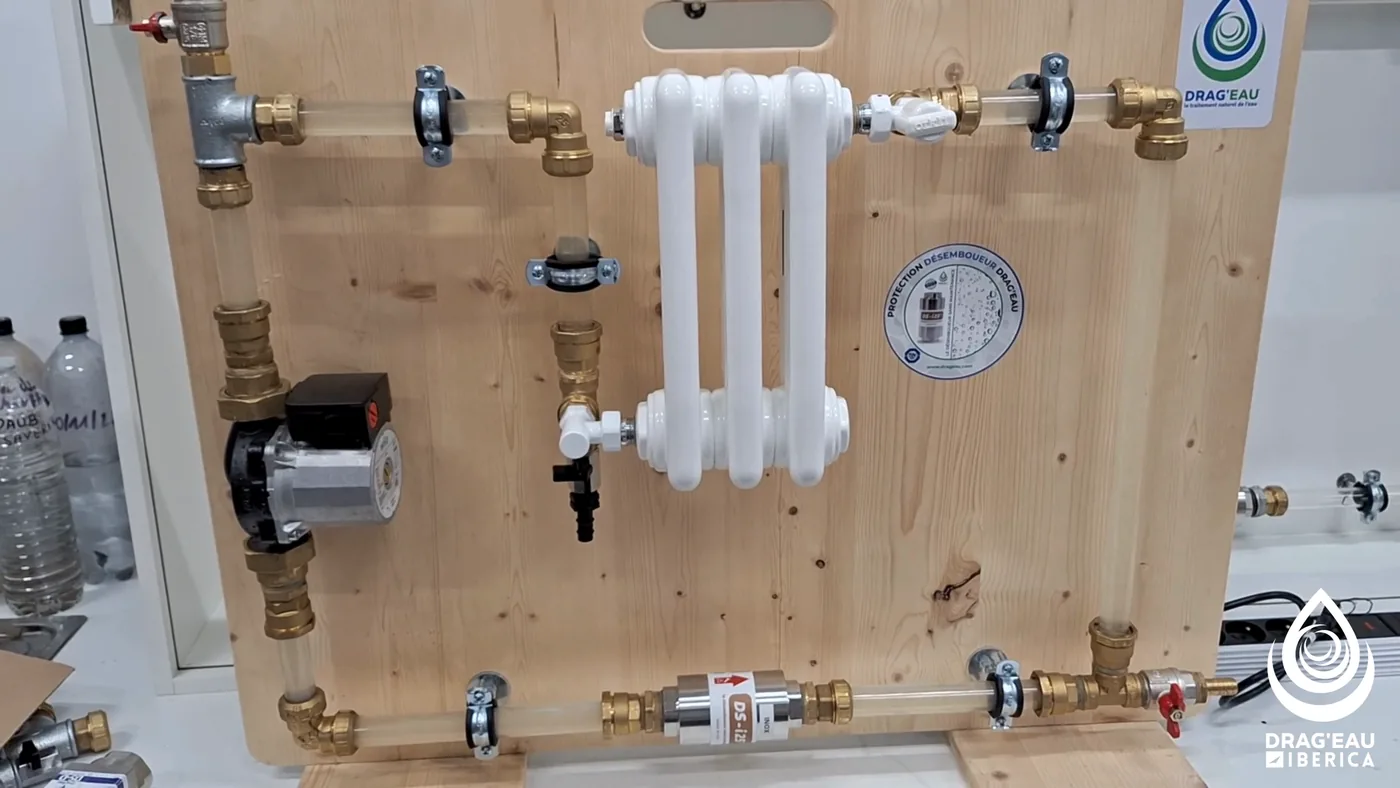
- A family of treatments that act on how water behaves without changing its composition: they remove no minerals, add no products and produce no discharge. In the DRAG'EAU range it rests on three linked effects: the vortex, Venturi acceleration and sonicophysical waves.
- PN16
- Nominal pressure of 16 bar. It designates a flange's pressure class and determines its bolt-hole geometry, so that it mates with the corresponding counter-flange.
- Pressure drop
- The loss of pressure caused by any element inserted into a pipe. In a physical treatment unit it is low and stable; in a filter it rises as the filter fouls.
- Preventive effect
- A treatment's ability to stop new scale forming. It acts from the first moment, but on its own it leaves accumulated deposit untouched.
- Sediment filter
- A cartridge or mesh that retains suspended particles from mains water. Fitted just after the meter, it protects the rest of the installation from grit and rust. It does not act on dissolved limescale.
- Softener
- Equipment that reduces water hardness using ion exchange resins. It consumes salt, discharges brine on every regeneration and needs a drain and a power socket.
- Sonicophysical waves
- Low-frequency mechanical waves generated by the vibration of the steel core when the Venturi effect accelerates the water. They are the third effect of DRAG'EAU treatment and are responsible for breaking up calcite and lifting existing deposit. No electric or magnetic field is involved: the phenomenon is mechanical.
- Straight run
- The length of pipe free of elbows, valves and tees that must be respected before and after a physical treatment unit, with a minimum of 20 cm on each side. It is what allows the vortex effect to form correctly.
- Stainless steel 316L
- Austenitic stainless steel with molybdenum and low carbon content, of food and surgical grade. It is the material of the DRAG'EAU unit bodies: its durability in a water environment is effectively indefinite.
- Brine
- The concentrated sodium chloride solution that regenerates a softener's resin. After each cycle it goes to the sewer along with the captured calcium, and there is no practical recovery route.
- TÜV SÜD
- German certification and technical inspection body, an international reference in product verification. It certifies both lines of the DRAG'EAU range.
- DVGW
- The German technical association for gas and water, whose certificate is one of the most demanding product references in Europe for drinking water installations.
- Venturi
- A narrowing of the flow path that accelerates the flow and locally lowers pressure. In DRAG'EAU units it is what sets the steel core vibrating and generates the sonicophysical waves.
- Vortexwhirl
- The rotation of water about its own axis, produced by the unit's internal geometry. It multiplies the water's kinetic energy and its dissolving power. The principle draws on Viktor Schauberger's work on the natural movement of water.
Closed circuits and sludge
- Biofilm
- A film of micro-organisms attached to the inner walls of a circuit. It thrives especially at low temperature, which makes underfloor heating a favourable case. It adds to the oxide and accelerates fouling.
- Chemical flushpower flush
- The cleaning operation for a closed circuit: drain down, circulate a descaling and dispersing product, then rinse. It is curative and one-off. Without a permanent measure behind it, the circuit fouls again.
- Closed circuit
- An installation where water circulates in a loop without renewal: heating, underfloor heating, fan coils, air conditioning, district heating. Its problem is not limescale but corrosion sludge.
- Corrosion inhibitor
- A chemical dosed into the circuit water to slow corrosion. It works while the concentration holds, so every drain-down or top-up requires checking and redosing.
- Dissolved oxygen
- Oxygen present in the circuit water, the driver of corrosion. It enters with every top-up, through plastic pipe without an oxygen barrier, through poorly set expansion vessels or through faulty air vents.
- District heatingheat network
- An urban network distributing hot water from a central plant to several buildings. It is a large-volume closed circuit, where the cost of chemical maintenance and of a service interruption are both high.
- Expansion vessel
- The vessel that absorbs the expansion of water as it heats and keeps circuit pressure within range. Undersized or with lost charge, it causes pressure dips that draw air in and feed corrosion.
- Galvanic corrosion
- Accelerated corrosion that occurs when two different metals are in contact through water. In a circuit combining steel radiators, copper pipe and an aluminium exchanger, it is a constant source of particles.
- Glycol
- Antifreeze added to the water of circuits exposed to cold. It changes the fluid's viscosity and heat transport capacity, and its concentration needs periodic checking.
- Legionella
- A bacterium that can proliferate in domestic hot water systems at lukewarm temperature. Prevention relies on holding hot water at 60 °C and on avoiding the rough surfaces where biofilm fixes, which adds a hygiene argument for keeping installations free of scale.
- Magnetic filtersludge filter · sludge separator
- A filter fitted on the return that captures circulating particles, usually with a magnet for the ferrous ones. It retains what already circulates, but does not stop it forming and does not act on what is stuck; it needs emptying regularly.
- Magnetite
- Fe₃O₄, the magnetic iron oxide that makes up the bulk of the black sludge in a heating circuit. Its ferromagnetic nature is what allows a magnetic filter to capture it.
- Make-up watertop-up water
- Fresh water added to a closed circuit to replace losses. Every addition brings in dissolved oxygen and feeds corrosion, so a circuit needing frequent top-ups has a leak to find.
- Purge
- The operation of drawing off water and sediment through a low point or an air vent. In a circuit with permanent treatment, it is the route by which suspended particles leave.
- RITE
- The Spanish regulation for thermal installations in buildings. Among other things it requires water treatment to be provided for closed circuits in order to prevent corrosion and scaling, leaving the method to the designer.
- Sludge
- The dark deposit that accumulates in the low points of a closed circuit. It is a mixture of iron oxides, metal particles, biofilm and installation debris. It behaves as thermal insulation and forces the generator to consume more.
- Underfloor heating
- A heating system using a circuit embedded in the floor screed, of small bore and low working temperature. Those two characteristics make it especially vulnerable to sludge and biofilm, and unlike a radiator it cannot be removed for cleaning.
Going further
- What limescale really is and why it sticks, for the full scaling mechanism.
- Water hardness in Spain, with unit conversions and how to measure your own.
- Sludge in closed circuits, on the origins of corrosion and its symptoms.
- Salt softener or physical treatment, the comparison between the two families.
About this article
Written by the DRAG'EAU Ibérica technical team, drawing on the product range's technical data sheets, product certificates and hands-on installation experience across Spain, Portugal and Andorra. Ranges and estimates are identified as such in the text.
More from the blog
Keep reading
Limescale and hardness Limescale and hardness
Water hardness in Spain: how it is measured and what you have at home
French degrees, German degrees, ppm, mg/L of calcium carbonate: the same figure gets published four different ways, which complicates something that ought to be simple. Here are the conversions, the reference scale, an indicative map of Spain and the two reliable ways to measure your own water.10 min read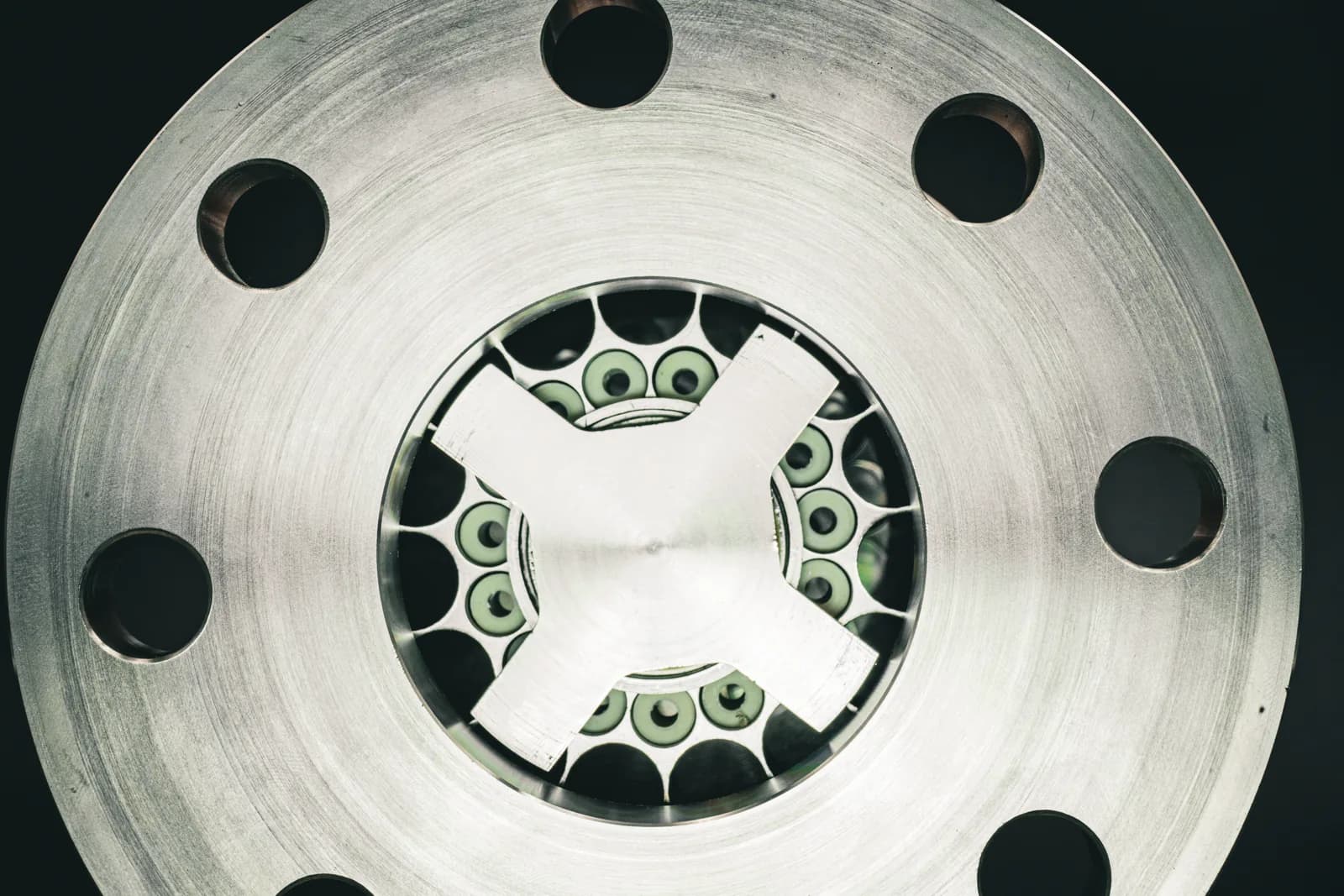 Sludge and heating
Magnetic filter or permanent treatment: what each one actually does
They do not even go in the same place, and both promise a clean circuit, but they do not solve the same thing. One captures particles; the other acts on their ability to adhere. We compare scope, maintenance, effect on existing deposit and the cases where fitting both makes sense.10 min readNewsletter
We'll tell you about every new article
We publish technical guides on water treatment, with no fixed schedule and no filler. Leave your email and we'll let you know when the next one is out.